Have you ever wondered whether God is responsible for what happens to us when we disobey Him? When we choose to walk down a path He warned us against and eventually experience the consequences of that decision, is God the One causing our suffering, or are we simply experiencing the results of the choices we made?
This is a question I have been reflecting on lately, especially when thinking about the purpose behind God’s instructions. When God tells us not to do something, is He simply giving us rules to follow, or is He trying to protect us from dangers we cannot yet see? Could it be that some of the things we perceive as unnecessary restrictions are actually expressions of His love and wisdom?
Sometimes, when things go wrong in our lives, we are quick to blame God. We wonder why He allowed certain things to happen, why He did not intervene, or why He did not protect us from the consequences of our decisions. But how often do we stop to consider whether the very situation we are asking God to rescue us from is something He had already warned us about?
Now, this does not mean that every painful experience is the result of disobedience, or that God never intervenes in judgment. Scripture gives us a more complex picture than that. However, understanding the relationship between obedience, consequences, and God’s character can completely change the way we view His instructions.
The Goat of Monsieur Seguin: When a Warning Feels Like a Restriction
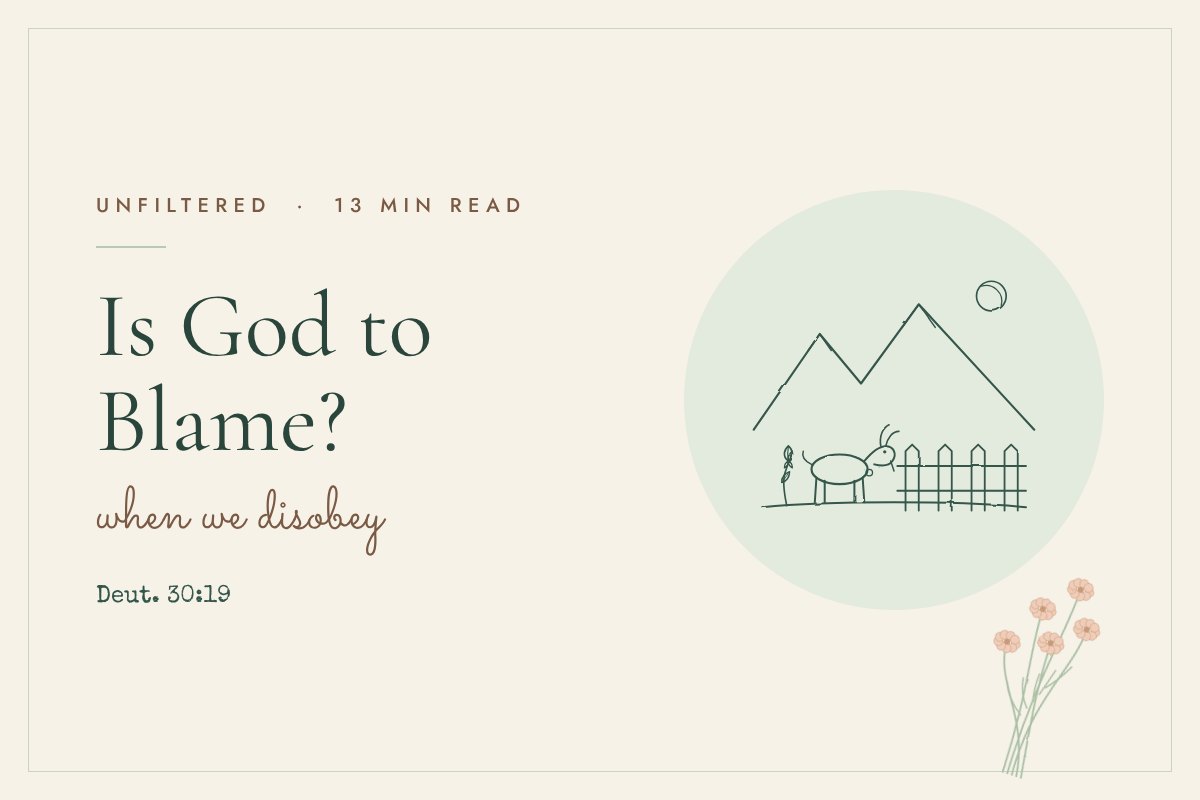
There is a French story called The Goat of Monsieur Seguin (La Chèvre de Monsieur Seguin), written by Alphonse Daudet, that I used to hear when I was little. It is one of those childhood stories that stayed with me, and the more I reflect on it, the more I see how it illustrates the importance of listening to warnings, even when we do not fully understand them.
In the story, Monsieur Seguin had a problem with his goats. No matter how well he cared for them, they eventually became dissatisfied with living in their enclosure and longed to escape into the mountains. Unfortunately, every goat that escaped ended up being eaten by a wolf.
One day, Monsieur Seguin acquired a beautiful young goat named Blanquette. He loved her dearly and provided her with everything she needed. She had food, shelter, and a safe place to live. But despite all of this, Blanquette could not stop thinking about the mountains. She imagined the freedom of running through the meadows, eating fresh grass, and exploring everything beyond the fence.
Monsieur Seguin warned her repeatedly about the wolf. He told her what had happened to the other goats and tried to convince her to stay. But Blanquette was determined to experience the freedom she had been dreaming about. Eventually, she found a way to escape.
And for a while, everything seemed wonderful. She ran through the mountains, enjoyed the scenery, and experienced the freedom she had wanted for so long. But when evening came, she heard the wolf. Despite fighting courageously throughout the night, Blanquette was eventually defeated and devoured.
Now, here is the question I want us to consider: Was Monsieur Seguin the one who killed Blanquette? Was he responsible for the wolf’s attack simply because he had warned her about it?
Of course, the wolf was responsible for attacking her. But the story also shows us that Blanquette had been warned about a danger she did not fully appreciate. She saw the fence as something standing between her and freedom, while Monsieur Seguin saw the danger that waited beyond it.
And that is what makes this story such a powerful analogy for obedience.
Sometimes, we become so focused on what God’s instructions appear to be keeping us from that we forget to consider what they may be protecting us from. We see the boundaries, but not the danger. We see what we cannot do, but not necessarily the wisdom behind why God is telling us not to do it.
Of course, this story is only an illustration, and our relationship with God is far greater than the relationship between Blanquette and Monsieur Seguin. Nevertheless, it raises an important question: What if some of the boundaries we are trying so desperately to escape are the very boundaries God has given us for our good?
God’s Instructions Are Not Arbitrary Restrictions
When we read Scripture, we discover that God’s instructions are deeply connected to His wisdom, holiness, and love for His people. He does not call us to obedience simply because He wants to make our lives unnecessarily difficult. His commands reveal what is good, and they teach us how to live in a way that honors Him.
In Deuteronomy 30:19, Moses presents the people of Israel with a choice between life and death, blessing and curse, and urges them to choose life. This passage belongs to God’s covenant with Israel, where obedience and disobedience carried specific promises and consequences. Yet it also reveals a broader principle that remains important for us today: our choices matter, and the direction we choose to follow can have consequences that extend far beyond the moment we make a decision.
I call heaven and earth to witness against you today, that I have set before you life and death, blessing and curse. Therefore choose life, that you and your offspring may live.
Imagine standing at the beginning of a road you have never traveled before. Someone who knows the area warns you that the bridge farther down has collapsed and that you need to take another route. But because you cannot see the damaged bridge from where you are standing, you decide that the warning is unnecessary and continue driving.
If you eventually encounter the danger you were warned about, would it make sense to blame the person who tried to stop you from taking that road? The warning did not create the danger. It was given because the danger was already there.
In a similar way, some of God’s instructions warn us about patterns of behavior that lead to destruction. Proverbs 14:12 reminds us that a way can appear right to a person while ultimately leading to death. Galatians 6:7 teaches that we reap what we sow. These passages remind us that the decisions we make have consequences, whether we recognize them immediately or not.
There is a way that seems right to a man, but its end is the way to death.
Think about dishonesty, for example. When Scripture teaches us to be truthful, it is not simply because lying is forbidden. Dishonesty can destroy trust, damage relationships, and create situations that become increasingly difficult to repair. Similarly, when God warns us against bitterness, pride, greed, or sexual immorality, He is not arbitrarily trying to remove joy from our lives. His Word is teaching us to recognize the spiritual and relational harm that sin can produce.
And sometimes, the consequences of our decisions do not appear immediately. Just as a seed does not produce a harvest the moment it is planted, certain choices take time to reveal their effects. We may continue down a particular path for months or even years before recognizing the damage it has caused.
Do not be deceived: God is not mocked, for whatever one sows, that will he also reap.
This is why obedience requires trust. We will not always understand why God instructs us to live a certain way, and we may not immediately see the consequences of disobedience. But we must learn to trust that His wisdom extends beyond what we can see in the present moment.
Obedience is not simply about avoiding punishment. It is also about trusting the wisdom and goodness of the One who is guiding us.
The Young Prophet: When Disobedience Has Serious Consequences
There is another story in the Bible that comes to mind when reflecting on this subject, and it is found in 1 Kings 13.
The passage tells us about a man of God who was sent to deliver a message to King Jeroboam. God gave him specific instructions for his journey. He was not to eat bread, drink water, or return by the same road he had taken.
At first, the prophet obeyed. He delivered the message and refused the king’s invitation to eat and drink. However, as he was returning home, an older prophet approached him and claimed that an angel had instructed him to bring the man of God back to his house for a meal.
The Bible explicitly tells us that the older prophet was lying (1 Kings 13:18). Yet the younger prophet believed him and returned with him, despite the instructions God had already given.
And what happened afterward was tragic.
While the younger prophet was traveling again, a lion encountered him and killed him. In 1 Kings 13:21-26, Scripture presents this event as judgment for his disobedience. The passage even states that the Lord had given him over to the lion.
This is an important detail because we must be careful not to explain away what Scripture actually says. Unlike the story of Blanquette, where the danger came from a wolf in the mountains, the biblical account explicitly connects the prophet’s death to God’s judgment. We cannot simply conclude that God had warned him about an ordinary danger and that his death was an unrelated accident.
However, the story still teaches us something important about obedience.
The young prophet had received clear instructions from God, but he allowed another person’s words to persuade him to disregard them. The older prophet sounded credible, claimed spiritual authority, and even spoke about an angel. Yet his message contradicted what God had already commanded.
How often do we find ourselves in similar situations? We know what Scripture teaches, but someone comes along with an explanation that makes disobedience sound reasonable. Sometimes, we even convince ourselves that because something feels right, it must be acceptable to God.
The story of the young prophet reminds us that we must exercise discernment and remain grounded in God’s Word, especially when other voices encourage us to compromise what we already know to be true.
But there is another lesson we need to understand. God’s judgment in this particular story does not mean that every painful thing that happens to us should automatically be interpreted as punishment for disobedience.
And that distinction is incredibly important.
Not Every Painful Experience Is God’s Punishment
One of the dangers of misunderstanding the relationship between disobedience and consequences is that we may begin assuming that whenever something bad happens, somebody must have done something wrong.
Someone loses their job, and we assume they must have disobeyed God. Someone becomes sick, and we wonder whether they are being punished. Someone experiences a painful season, and we immediately start searching for a mistake that could explain their suffering.
But the Bible does not teach us to interpret every hardship this way.
In John 9, Jesus encountered a man who had been blind from birth. His disciples asked whether the man’s blindness was caused by his sin or his parents’ sin. Jesus rejected both explanations and revealed that the works of God would be displayed in him.
Likewise, in Luke 13:1-5, Jesus challenged the assumption that people who suffered tragic deaths were greater sinners than those who had not experienced the same tragedies.
These passages remind us that suffering is not always the result of a person’s wrongdoing. Sometimes, we experience the natural consequences of our choices. Sometimes, Scripture specifically identifies an event as God’s judgment or discipline. And other times, we experience hardship simply because we live in a fallen world where suffering, injustice, sickness, and tragedy exist.
We cannot always know why something happened, and we should be careful about claiming to know God’s specific intentions when He has not revealed them.
This also means we must be compassionate toward people who are suffering. Not every person experiencing hardship needs someone to explain what they must have done wrong. Sometimes, what they need is someone to pray with them, support them, and remind them of God’s love.
Wisdom is recognizing that our decisions have consequences without assuming that every painful circumstance is evidence of God’s punishment.
What Should We Do When We Have Disobeyed God?
Now, perhaps you are reading this article and realizing that you have made decisions that went against God’s Word. Maybe you ignored a warning, compromised your convictions, or knowingly chose something you understood was wrong. And now, you are dealing with consequences you wish you could escape.
What should you do?
The first thing is to take responsibility for your actions. Sometimes, we become so focused on asking God why He allowed something to happen that we forget to acknowledge the role our own decisions played in creating the situation. If we have sinned, we need to be willing to call it what it is, repent, and make things right wherever possible.
But we must also remember that God’s mercy does not disappear when we disobey Him.
First John 1:9 reminds us that when we confess our sins, God is faithful and just to forgive us and cleanse us from unrighteousness. This does not mean the consequences of our decisions will always disappear, but it does mean that repentance opens the way for restoration in our relationship with Him.
If we confess our sins, he is faithful and just to forgive us our sins and to cleanse us from all unrighteousness.
Consider David. After his sin involving Bathsheba and Uriah, he faced painful consequences, yet when confronted by the prophet Nathan, he acknowledged his wrongdoing. His story reminds us that forgiveness and consequences can exist at the same time.
And that is something we need to understand. God’s forgiveness does not always mean He will remove every consequence of our disobedience, but the presence of consequences does not automatically mean He has stopped loving us.
Sometimes, the greatest step we can take after making a wrong decision is to stop blaming God, acknowledge where we went wrong, and begin walking in obedience again.
We cannot always undo the past, but we can learn from it. We can seek God’s wisdom, change our direction, and trust Him to guide us through what comes next.
Conclusion: God’s Warnings Are an Expression of His Love
Perhaps the next time God tells us not to do something, instead of immediately focusing on what we feel we are losing, we should consider what He may be trying to protect us from.
Because sometimes, like Blanquette, we become so fascinated by what lies beyond the fence that we forget there may be dangers we cannot yet see. We become convinced that freedom means being able to do whatever we want, without recognizing that some choices can eventually lead us into circumstances that limit the very freedom we were trying to find.
But true freedom is not simply the absence of boundaries. It is also the wisdom to recognize which boundaries exist for our good.
And while we must acknowledge that Scripture sometimes describes God’s direct judgment, we should not assume that He is personally inflicting every painful consequence we experience. Some consequences flow naturally from our decisions, while other hardships have nothing to do with our personal disobedience.
What matters is that we learn to approach God’s instructions with trust rather than resentment. His commands are not arbitrary obstacles standing between us and happiness. They are expressions of His wisdom, holiness, and love.
So when God calls you to obedience, remember that He sees what you cannot see. He knows what you do not know, and His Word provides guidance for paths you have not yet traveled.
And if you have already disobeyed Him, remember that His mercy is still available. You can repent, take responsibility, and begin walking with Him again.
Because the God who warns us against disobedience is also the God who calls us to repentance, offers forgiveness through Jesus Christ, and invites us to return to Him.
His instructions are worthy of our trust, and His mercy is greater than our failures.
Read the Scripture passages
Found this helpful? Share it with someone who needs it.